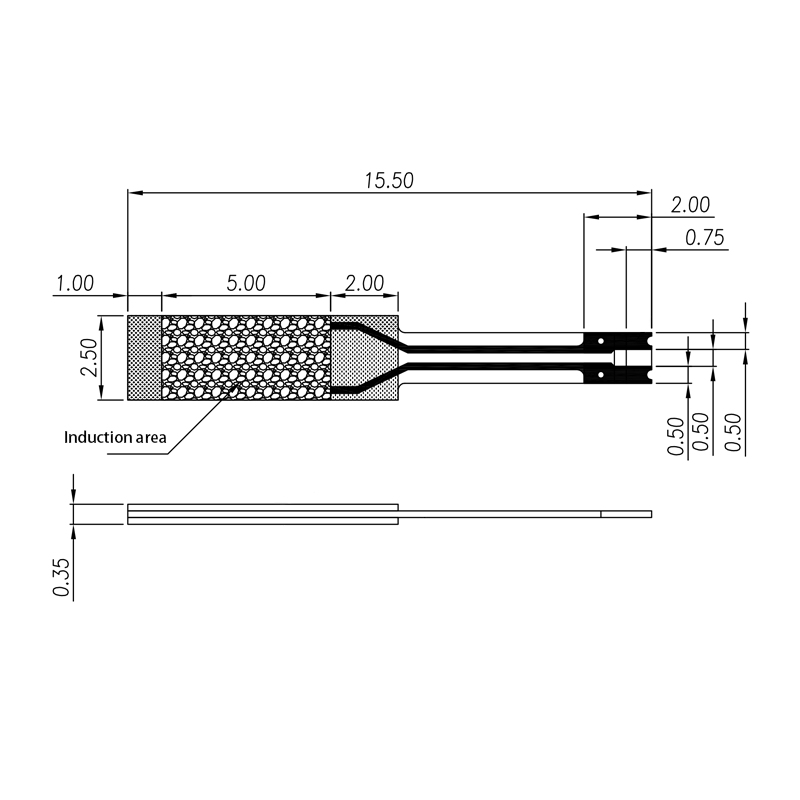


The RP-W2.5-L15.5 is a single-zone Force Sensitive Resistor (FSR) designed for small, low-power applications requiring accurate force detection in a thin and flexible form factor. This 0.30 mm-thick film sensor responds to applied force with a corresponding decrease in resistance, making it ideal for touch, pressure, and load-sensing applications.
How It Works
Force Sensitive Resistors exhibit a variable resistance that drops as pressure increases on the sensing area. As a two-terminal analog device, it behaves like a force-controlled variable resistor — or, in switching applications, a force-controlled threshold switch.
Technical Specifications
| Parameter | Details |
| Thickness | 0.30mm (with rear adhesive) |
| Shape | Flexible Film |
| Actuation Force | 5g |
| Sensitivity Range | 5g to 1kg |
| Mode of Action | Soft Contact Compression |
| Operating Temperature | –20°C to +65°C |
| Life Time | > 1 million actuations |
| Active Range | 5g - 1kg |
| Mechanical Size |
Length 15.5 mm, width 2.5 mm (RP-W2.5-L15.5), thickness 0.30 mm |
Application Circuits
Voltage DividerA simple method to convert force into analog voltage.
The sensor (Rs) is placed in series with a fixed resistor (R0). Output is taken across R0:
Vout = Vcc × R0 / (R0 + Rs)
Choosing R0:
- Select a value between 1/3 to 1/2 of the FSR’s resistance range.
- An appropriate R0 produces a near-linear force-to-voltage curve in the desired force window.
- The output may be followed by an op-amp depending on the input impedance required by the measuring device (e.g., ADC).
Ideal for on/off force detection.
Uses a Wheatstone bridge feeding a comparator:
- When force reduces Rs below R1, the comparator sees U1+ > U1-, causing Vout = HIGH.
- This output can directly trigger downstream devices such as:
- Relays
- LEDs
- Buzzers
- Motors
- Logic-level digital inputs
This configuration is useful for touch switches, pressure triggers, safety alerts, and mechanical contact detection.
Custom Sensor Options
Customized versions can be produced to meet unique requirements, including:
- Custom shapes, lengths, widths
- Tailored force vs. resistance curves
- Specialized materials or thickness
- Multiple active zones
- Custom connector interfaces